Physics-inspired neural compression

The geometry of prediction.

Amplituhedron AI compresses high-dimensional models into positive geometry — turning pages of matrix algebra into a single luminous volume. Causal. Interpretable. Memory-efficient by construction.

input → G⁺(k,n) volume V(x) amplitude a(x)
01 The cost of algebra

Modern AI is winning by brute force —
and hitting a wall.

Dense matrix multiplication scales quadratically. Every new dimension multiplies memory and compute, forcing models onto ever-larger clusters. Worse, the math is opaque: it learns correlation, not cause, and can't tell signal from noise.

Quadratic growth
O(N²)

Cost rises with the square of model size. Twice the features, four times the burden.

Hardware dependence
GPU / TPU clusters

Dense weight matrices saturate memory, pushing real work onto specialized fleets.

The black box
Correlation ≠ cause

Opaque matrices conflate the two, overfit to noise, and resist interrogation.


02 A different mathematics

What if the computation
were the shape itself?

// the discovery

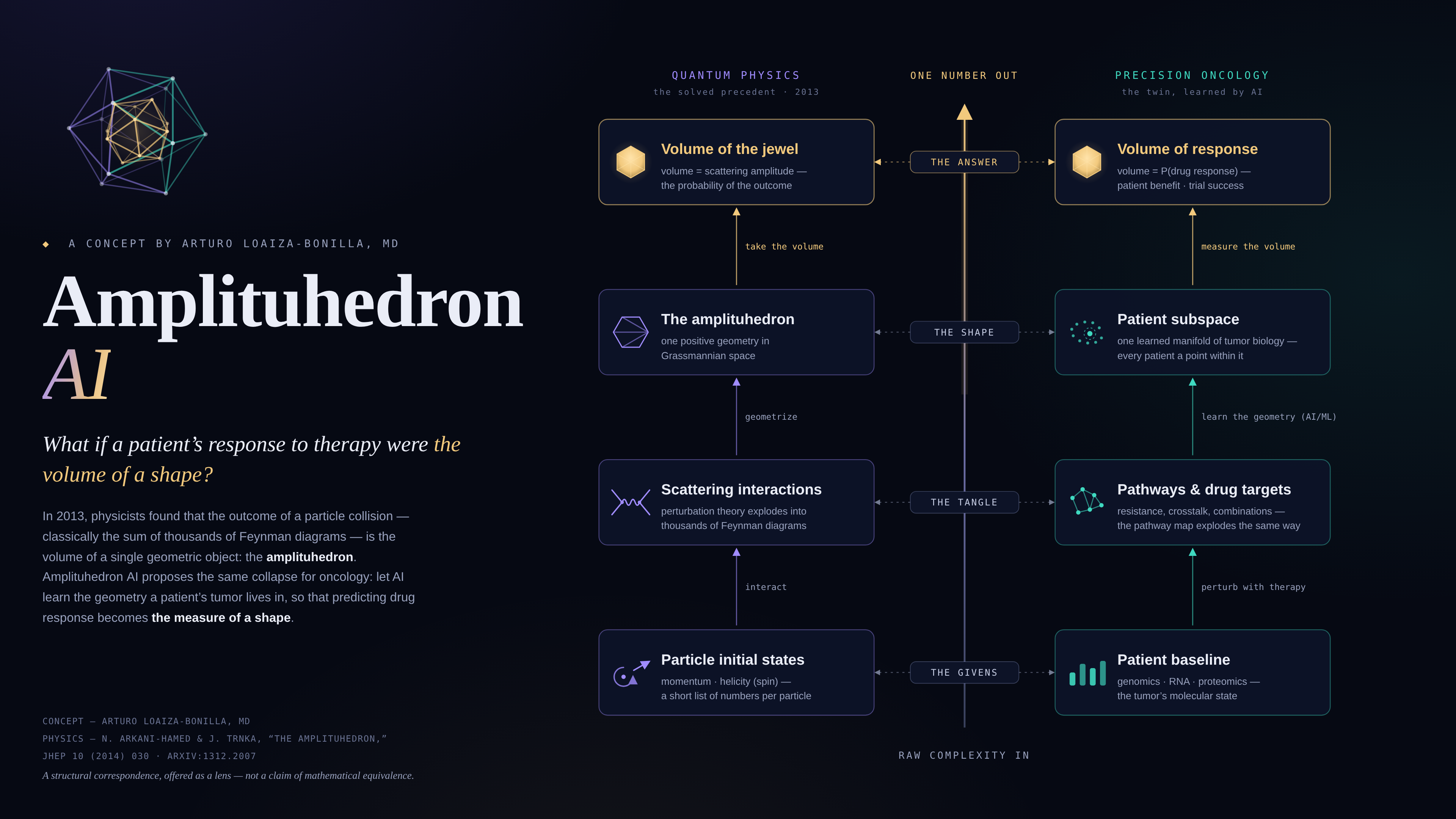
2013 — Nima Arkani-Hamed & Jaroslav Trnka introduce the amplituhedron: a geometric object whose volume encodes the scattering amplitudes that once demanded summing millions of Feynman diagrams.

Locality and unitarity stop being assumptions. They emerge as properties of the shape.

Pages of algebra collapsed into a single volume. Amplituhedron AI carries that idea into machine learning: map data to a positive geometry, and read prediction off its volume.

Neural networks face the same combinatorial explosion as particle physics — the probability of an outcome across thousands of genomic, imaging, and clinical variables. Where the old approach sums interactions term by term, the geometry computes once. Less algebra. Less memory. More meaning.

03 The engine

The Q-Layer™ — a positive-geometry
replacement for dense matrix multiplication.

From shape to signal in three moves. End-to-end differentiable, so it drops into existing gradient-based training without rebuilding your stack.

i

Embedding G⁺(k,n)

Each input maps to a point in the positive Grassmannian — the space of k-planes in n dimensions with non-negative coordinates.

ii

Constraints Az ≥ 0

The point defines a positive geometric form, bounded by a set of inequality constraints. Only valid, "positive" configurations survive.

iii

Calculation V(x)

The form's volume is computed via triangulation or Monte-Carlo integration and normalized into a probability amplitude — the prediction.

V(x) ⟶ a(x)   volume = probability amplitude
Computational cost vs. model size
O(N²) dense O(N)→O(N log N) model size (N) cost / memory
dense matrix multiplication positive geometry / low-rank tensors

// what's open, what's ours

The mathematics of positive geometry is public and peer-reviewed. The method that makes it a trainable, memory-efficient layer — the parameterization, the differentiable volume estimator, the training procedure — is proprietary and patent pending.


04 The filter

It learns cause,
not coincidence.

Before the geometry is built, a causal manifold computes the Fisher-information structure of the data and isolates the sloppy directions — parameter combinations that barely move predictions. They're attenuated or pruned, leaving a compact, stiff core of genuinely causal structure. The result stays robust on the noise that makes real-world data — genomics, EHR, sensor streams — so hard.

in
Longitudinal data
EHR · genomics · imaging over time
build
Causal manifold
a continuous state space
measure
Fisher information F
sensitivity of every direction
cut
Prune sloppy directions
small eigenvalues = noise
map
→ Q-Layer
stiff, causal core only
05 The interface

Drag the intervention.
Watch the future move.

Spacetime-Canvas™ turns the model into something a clinician can interrogate. Grab the intervention node on a trajectory and the counterfactual path recomputes in real time — showing not just the likely outcome, but how stable that outcome is.

Spacetime-Canvas · counterfactual trajectory
Δ at horizon: +0%  — stiff
1.6×
baseline counterfactual stability band

Illustrative interactive demo of the counterfactual interface. Not a clinical prediction.


06 Evidence

Fewer parameters. Same accuracy.
Commodity hardware.

Predictive oncology
−70%
parameters, with predictive performance held at AUC 0.83 across 2,000 patients and 20k gene-expression features.
Baseline22M
Q-Layer6.5M
MNIST classification
−95%
parameters, at 97.5% accuracy versus a 97.8% dense baseline — under 0.3 points of loss.
Baseline535k
Q-Layer27k
Language modeling
~−60%
projected memory reduction on transformer feed-forward blocks, compressed into Q-Layer geometry.
Dense FFN1.0×
Q-Layer FFN0.4×
projected · in validation

Figures from internal benchmarks; the language-model result is a projection under active validation. Clinical and research applications are decision-support and research tools — not diagnostic devices.


07 The platform

One geometry.
A platform of products.

The Q-Layer is the engine. Around it, a suite that meets teams where their hardest problems already live.

Nice Cl. 9 · 42
Q-Core
engine · SDK & API

The positive-geometry compute layer, delivered as a developer toolkit and API. Drop neural compression, causal inference, and federated learning into existing models on classical hardware.

  • neural compression
  • causal inference
  • federated learning
  • multimodal integration
Nice Cl. 42 · 44
Clinical Intelligence
SaaS · decision support

Survival and risk modeling, clinical-trial matching and optimization, and precision-medicine decision support — with patient-trajectory simulation through Spacetime-Canvas.

  • survival modeling
  • trial matching
  • trajectory simulation
  • precision oncology
Nice Cl. 42
Discovery
research · simulation

Molecular simulation, virtual screening, and drug-repurposing analytics on geometric descriptors — treating binding and folding as scattering problems solved by volume, not brute-force dynamics.

  • molecular simulation
  • virtual screening
  • drug repurposing
  • bioinformatics
Nice Cl. 35
Advisory
consulting · strategy

AI implementation, real-world-evidence strategy, and data-interoperability and regulatory readiness for pharmaceutical, life-sciences, and health-system partners.

  • AI implementation
  • RWD / RWE strategy
  • interoperability
  • regulatory readiness

Available today, in pilot, or on the roadmap — tell us where your problem fits.

08 Horizons

Positive geometry is
domain-agnostic.

Oncology is where it was forged. But wherever complexity scatters, a volume can describe it — and the same architecture reaches well beyond medicine.

Σ.01

Life sciences

Drug discovery, binding affinity, and protein dynamics as one-shot geometric predictions.

Σ.02

Financial dynamics

Volatility surfaces and risk as deformations in a geometric state space.

Σ.03

Materials

Crystal lattices and failure modes modeled as positive versus collapsing geometry.

Σ.04

Quantum models

Noise-aware architectures rooted in topological field theory.

Σ.05

Edge & aerospace

Geometric compression for inference under bandwidth and latency limits.


09 Why positive geometry

Four properties, by design.

Memory-efficient

Sub-quadratic scaling replaces dense matrices with low-rank geometric descriptors, so models fit on commodity CPUs and standard GPUs.

Causal & robust

Fisher-information filtering separates genuine signal from correlation, suppressing the sloppy noise that makes other models overfit.

Interpretable

Structure replaces opaque weight matrices. The geometry of a prediction is something you can inspect, not just a number from a black box.

Interactive

Real-time counterfactual simulation lets people steer a decision and see the consequence — and its stability — instantly.

10 Science & intellectual property

Open foundations.
Defensible method.

We stand on published physics, and protect the specific advance that turns it into a trainable architecture.

Scientific lineage — public
  • The amplituhedron
    Arkani-Hamed & Trnka, 2013 — scattering amplitudes as the volume of a polytope.
  • Positive Grassmannian G⁺(k,n)
    k-planes in n dimensions with non-negative coordinates.
  • Momentum twistors
    variables that simplify the geometric description of scattering.
  • Sloppy-model theory
    Fisher-information sensitivity, stiff and sloppy parameter directions.
Amplituhedron · geometric object whose volume is an amplitude Sloppy parameters · small-eigenvalue directions, low impact
Our IP — proprietary
  • Trademark — AMPLITUHEDRON AI™
    USPTO Serial No. 99,487,146 · Notice of Allowance issued June 2026.
  • Patent pending
    "Memory-Efficient Positive Geometry Layers for Predictive Models," 2026.
  • Q-Layer™ · Causal Geometric Manifold · Spacetime-Canvas™
    the trainable layer, the causal pre-processor, and the counterfactual interface.
  • Inventor
    Dr. Arturo Loaiza-Bonilla.
Method, not mathematics.  Foundations public — implementation confidential.

11 Founder
Portrait of Dr. Arturo Loaiza-Bonilla
INVENTOR · AMPLITUHEDRON AI

Dr. Arturo
Loaiza-Bonilla

MD, MSEd, FACP · physician–scientist, AI architect & oncology executive

Dr. Loaiza-Bonilla works at the convergence of clinical medicine, artificial intelligence, and large-scale clinical-research infrastructure — a physician–scientist who builds the systems he once wished existed at the bedside.

He founded Amplituhedron AI to pursue a single conviction: that the brute-force statistics dominating modern AI can be replaced by something more efficient, more causal, and more legible — the positive geometry that once simplified the laws of physics. His mission is to carry that idea across oncology and far beyond it — drug discovery, materials, financial systems, and inference at the edge.

Nature doesn't compute by brute force. It finds the shape.
  • Physician–scientist · MD, MSEd, FACP
  • Inventor of the Amplituhedron AI architecture · 4 U.S. AI patents
  • 60+ peer-reviewed publications across oncology & applied AI
  • Building at the convergence of medicine, AI & clinical-research infrastructure
◆ Build on the geometry

Let's reshape what your
models can do.

For partnerships, pilots, licensing, and press. Tell us the problem you're trying to compute — we'll show you the shape of it.